The roll-out of hydrogen fuel cell buses is advancing worldwide, driven by technology improvements, expanding Original Equipment Manufacturer (OEM) participation, and the need to meet policy commitments. As fuel cell technologies advance and deployment scales increase, the long-term outlook for platinum demand from hydrogen fuel cells used to power bus fleets continues to strengthen.
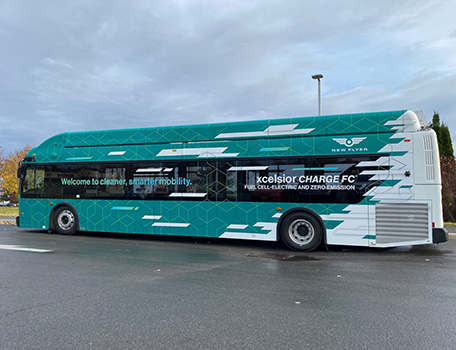
Earlier this month, North American bus manufacturer New Flyer signed an agreement with Ballard for the provision of 500 hydrogen fuel cell engines. This represents around 50 MW of hydrogen propulsion capacity and marks New Flyer’s largest commitment to Ballard since their collaboration began more than a decade ago. Deliveries, starting later in 2026, will power New Flyer’s Xcelsior CHARGE FC™ hydrogen fuel cell buses, a model designed to support public transportation agencies transitioning away from diesel fleets.
In a move that sees it making a shift from bus OEM to mobility solutions provider, Portugal’s CaetanoBus, part of Toyota Caetano Portugal and Mitsui & Co, has recently led a consortium to provide a comprehensive, end-to-end hydrogen mobility solution for the city of Porto, which has launched its first hydrogen-powered Bus Rapid Transit (BRT) system. Under the scope of the contract, CaetanoBus has assumed responsibility for not only the supply of twelve hydrogen fuel cell buses, but also the deployment and integration of a local green hydrogen production system and the installation of hydrogen refuelling station infrastructure, amongst other activities.
Regulatory alignment
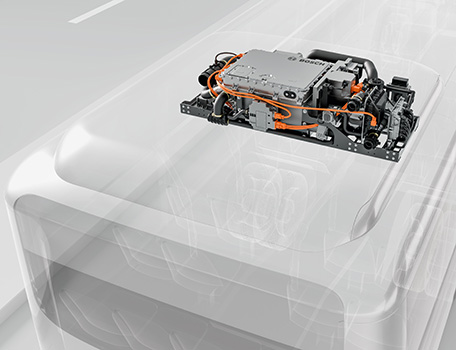
Meanwhile, Bosch is bolstering Europe’s supply landscape with the introduction of the FCPM C100, its new, rooftop-mounted fuel cell module designed for city buses. Bosch’s offering aligns with upcoming EU regulations stipulating that, by 2030, the carbon emissions of newly registered city buses must be reduced by 90% compared to 2019. Bosch believes that vehicles with fuel cell power modules, which the EU recognises as zero-emission vehicles, can make an important contribution here.
The FCPM C100 fuel cell module. Picture credit: Bosch
Japan is also advancing next generation fuel cell buses, with Toyota and Isuzu co-developing a new hydrogen fuel cell bus for commercialisation. The vehicle will be based on the flat-floor battery electric bus platform previously developed by Isuzu, with Toyota supplying the fuel cell system. The aim is to reduce costs by standardising battery electric vehicle and fuel cell electric vehicle (FCEV) parts.
Together, the two companies will work with local governments and businesses ― including those in areas designated by Japan’s Ministry of Economy, Trade and Industry as Priority Regions for Promoting the Deployment of Fuel Cell Commercial Vehicles ― to contribute to the steady reduction in CO₂ emissions by expanding the use of FCEVs.
Elsewhere in Asia, China has seen one of the largest single hydrogen bus deployments to date, with the delivery of 249 hydrogen fuel cell buses in Guangzhou alone. The vehicles will be gradually introduced into Guangzhou’s public transport network, supporting the city’s long-term low-carbon zero emissions mobility strategy. In South Korea, Hyundai Motor Company has launched its 2026 Universe hydrogen electric intercity bus, achieving an industry leading 960 km range, ten minute refuelling, and validated for durability across extreme climates.