As worldwide demand for data centre storage continues to grow, leading electronics business Toshiba is investing to expand its hard disk drive (HDD) business. It aims to nearly double annual production capacity by its full financial full year 2027 compared with its full financial year 2025 on a storage-capacity basis.
Toshiba’s expansion is focused on nearline HDDs. Nearline HDD capacity is used in enterprise, cloud, and hyperscale environments for data that does not need constant, real-time access, but must remain quickly available.
In the storage market, surging AI demand has created an HDD shortage, with supply largely committed through to the end of the year. This sustained demand has eliminated typical seasonal downturns and kept manufacturing lines running at full capacity. To secure fast-growing storage requirements, major cloud customers are considering extending long-term agreements with HDD suppliers through to 2028. This move both prolongs the HDD product lifecycle and secures future output volumes.
Electrical demand for platinum growing
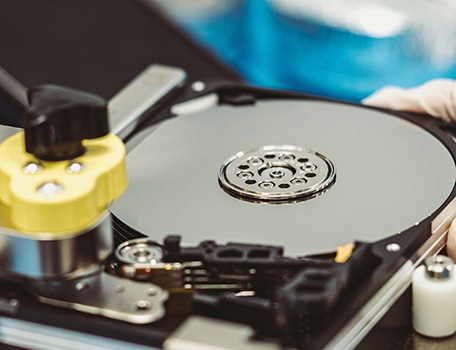
For full year 2026, electrical demand for platinum is forecast to grow by 19% year-on-year to 118 koz, boosted by AI-related demand, including HDDs, which are comprised of magnetic platters coated with a platinum alloy media to improve thermal and magnetic stability.
The HDD market is also benefiting from the introduction of heat-assisted magnetic recording (HAMR) technology, an innovation that has improved storage, or ‘areal’ density, growing storage capacity without increasing HDD size or power requirements. Rising shipments of HAMR drives are positive for platinum demand as the metal loading per unit is higher than on non-HAMR HDDs.
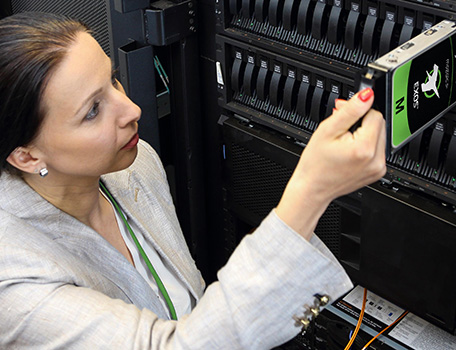
Picture credit: Seagate
Recognising the need to raise storage capacities, Toshiba is investigating the use of an innovative 12-disk stacking technology alongside next-generation HAMR. The goal is higher-capacity HDD solutions that keep up with ever-growing storage demands from data centres, while realising a lower total cost of ownership for customers.
Recent developments at the two other major HDD suppliers, Seagate and Western Digital, reinforce the constructive outlook for HDD demand.
Seagate has continued to ramp deployment of its HAMR-based products, with higher-capacity drives now being adopted by leading hyperscale cloud customers to support rapidly growing AI and data-centre storage requirements. At the same time, Western Digital has reported strong growth in nearline HDD shipments, driven by demand from large cloud operators, and has highlighted that long-term customer commitments are extending well beyond traditional ordering cycles.
HDDs are not the only data storage technology available and in certain markets they face strong competition from solid state drives (SSDs), especially in consumer applications such as personal computers and gaming consoles. SSDs do not contain platinum or platinum group metals and use memory chips to store data, typically with a flash memory. They are more expensive products than HDDs, and some evidence suggests that this cost differential is widening. For the purposes of the data centre growth currently being experienced to accommodate AI expansion, they have a different function to HDDs. SSDs are typically used for wherever fast-access storage, low latency, and high throughput are required, rather than the nearline storage that HDDs are used for.