
Expanding human understanding
The role of platinum in scientific discovery extends beyond measurement standards. It is also helping scientists observe phenomena at the very limits of human understanding.
The Laser Interferometer Gravitational Wave Observatory (LIGO) made history in 2015 with the first direct detection of gravitational waves, ripples in space-time first predicted by Albert Einstein almost a century earlier. An interferometer is a scientific instrument that splits a beam of wave energy, such as light, radio, or sound waves, into separate paths, and then brings them back together to create an interference pattern.
LIGO is, in fact, comprised of two separate infrared laser interferometers some 3,000 miles apart. Located in the US, each interferometer has two arms, 4 km in length, arranged in an ‘L’ shape. The interferometers work in unison, using mirrors to direct the paths of laser beams as they travel down each arm. It is minute changes in the length of the paths of the laser beams that indicate the presence of a gravitational wave.
LIGO's interferometers can detect distortions thousands of times smaller than a proton, requiring components and systems engineered to unprecedented levels of stability and precision. Within the interferometers, platinum-based resistance temperature detectors are used to monitor the temperature of the mirrors to ensure they are sufficiently heated to maintain their carefully calibrated curvature before the laser beams are directed down each arm.
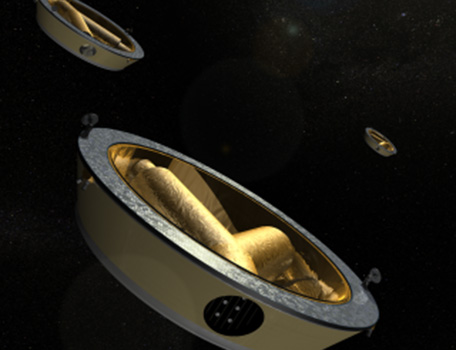
Earlier this year, engineers and scientists at NASA completed tests in relation to the Laser Interferometer Space Antenna (LISA) mission which is in planning for launch in the mid-2030s. While LISA and LIGO are both gravitational wave observatories, LISA will be a space-based observatory consisting of three spacecraft.
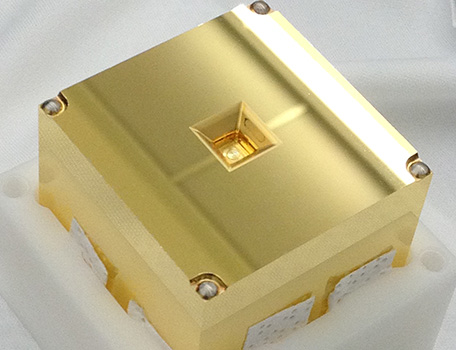
The three LISA spacecraft will fly in a vast triangular formation that follows Earth as it orbits the Sun. Each arm of the triangle will stretch 1.6 million miles (2.5 million kilometres) and each spacecraft will contain two free-floating cubes inside called ‘proof masses’. The cubes comprising the proof masses are made of a solid gold-platinum alloy. Each cube has sides of 4.6 cm and weighs 1.96 kg.
Arriving gravitational waves from throughout the universe will minutely change the lengths of the triangle’s arms. The lasers connecting the cubes will measure changes in their separation to within a distance smaller than a helium atom.