London Platinum Week Review: Broad confidence on the underlying markets albeit with some Iran war trepidation
29 May 2026
Last week, the PGM industry gathered for London Platinum Week where the primary themes included price resilience during external market uncertainty, recycling supply growth, increasing end uses in datacentres, and the need for more coordinated market development efforts. Against this backdrop, updated supply demand projections were released by several industry participants including the WPIC. Aggregating the outlooks, the platinum market is forecast to remain in deficit during 2026f, equivalent to 4% of average demand projections.
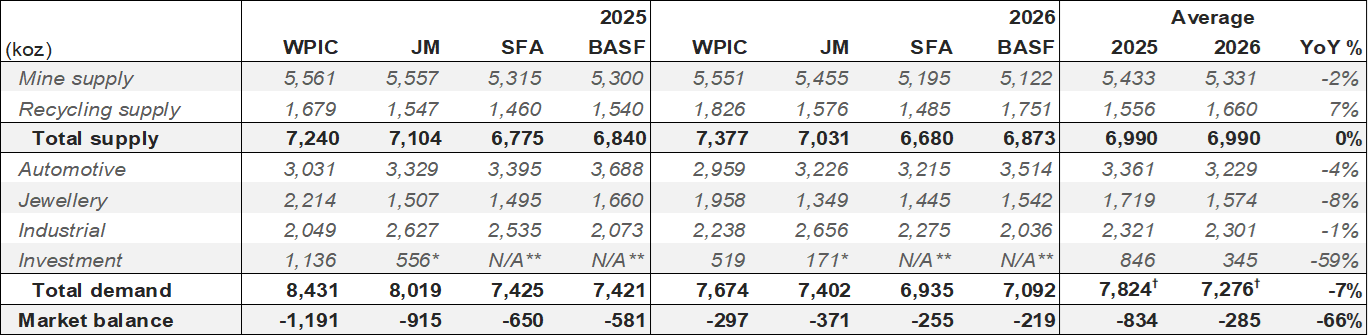
During platinum week, Johnson Matthey (JM), SFA (Oxford), BASF and WPIC (independently produced by Metals Focus) each released updated platinum supply demand estimates for 2025 and 2026f (Fig. 1). Supply is expected to be, on average across the forecasts, stable during 2026f (Fig. 2) as recycling growth offsets erosion across mining. Mine supply expectations were largely consistent, while recycling was topical during the week, and growth estimates across the four forecasts range from +1.7% to +13.7% YoY during 2026f. Notably, the large PGM recyclers, JM and BASF, diverge on the rate of growth in recycling volumes for 2026f. We recently highlighted that higher PGM prices are supporting recycling supply growth but that several headwinds may be capping the market’s potential output (link). Onerous working capital financing conditions and lower feed grades may be weighing on recycling supply growth and if the Iran war lingers on, slower economic growth could defer new car purchases and similarly scrappage rates. Reflecting on the variability of recycling supply, since 2022, recycling growth has consistently underperformed initial forecasts (Fig. 3).
Figure 1. Summary platinum supply demand forecasts presented during London Platinum Week
Turning to demand, average platinum demand is forecast to decline by 7% YoY during 2026f mainly due to lower investment demand (Fig. 5). As we previously noted, the Middle East is not a large direct PGM market (link), however, the Iran war is weighing on platinum investment. Non-yielding precious metals markets have been negatively impacted by upwardly revised interest rate expectations as inflation forecasts are raised due to restricted trade flows through the Strait of Hormuz. Platinum ETF holdings have decreased by 331 koz or 10%, since the end of February. Elsewhere, platinum demand is declining across jewellery (-8% YoY), automotive (-4%) and industrial (-1%) markets in 2026f with the drop in jewellery demand reflecting the 97% increase in the average monthly platinum price in May 2026 versus May 2025.
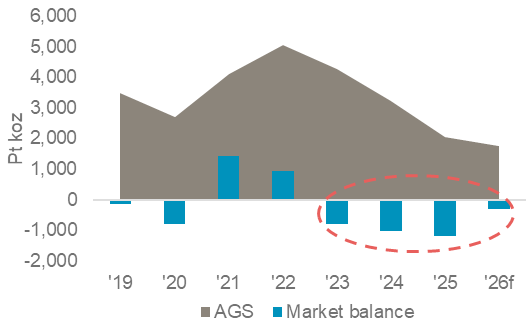
With a protracted Iran war representing some demand risk, the consolidated platinum market outlooks reflect an average annual deficit of 285 koz during 2026f. While the 2026f platinum market deficit is forecast to be smaller than that reported in 2025, above ground platinum stocks (AGS) are required to meet supply shortfalls. The WPIC estimates that four consecutive years of platinum market deficits will have depleted AGS by 65% (Fig. 7). In our view, depleting AGS combined with geopolitical competition for critical minerals and investors seeking physical asset exposure remain compelling aspects of the platinum investment case.
Platinum’s attraction as an investment asset arises from:
- WPIC research indicates that the platinum market entered a period of consecutive supply deficits from 2023, although a smaller deficit is forecast in 2026 it is not expected to alleviate current market tightness
- Platinum supply remains challenged, materially for mining supply, less so for recycling supply
- Platinum’s end markets are the most diversified of any of the PGMs which is supportive of long-term demand and mitigates future downside risks from external events (Iran War) or structural trends (drivetrain electrification)
- Elevated lease rates and OTC London backwardation highlight sustained tight market conditions
- The platinum price remains significantly below the price of gold
Figure 2: Total platinum supply is expected to be, on average, stable in 2026f
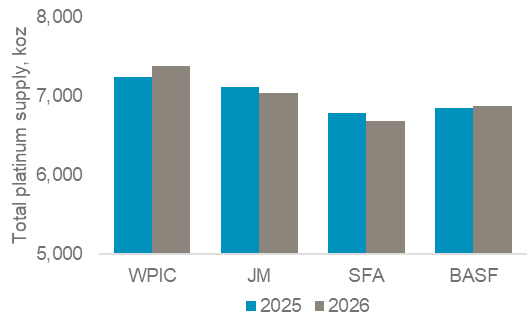
Figure 3: Platinum recycling has, in recent periods, underperformed initial forecasts
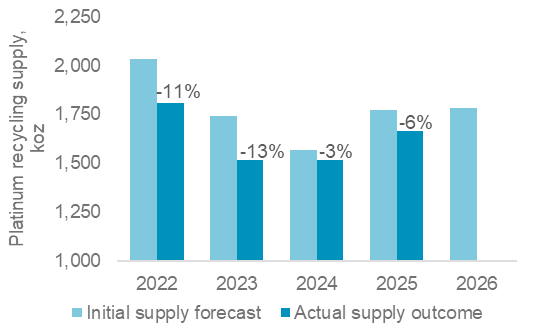
Figure 4: Total platinum demand is, on average, expected to decline by 7% year-on-year in 2026f
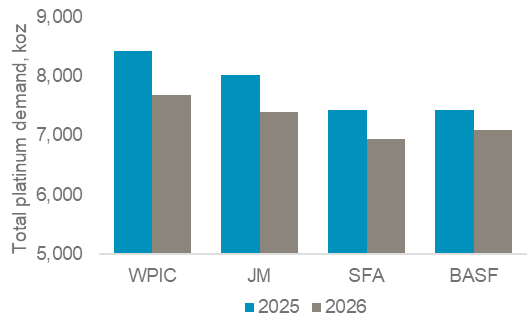
Figure 5: A decline in platinum investment demand is the largest factor underpinning lower platinum demand in 2026f
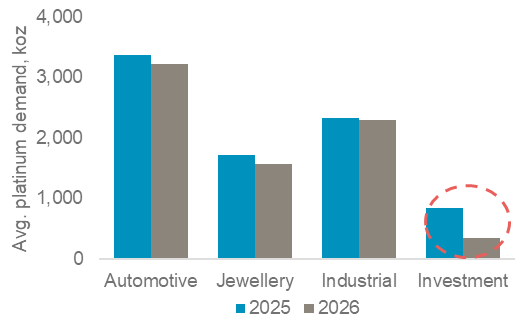
Figure 6: Since the start of the Iran war on 28 February 2026, platinum ETF holdings have decreased by 10%
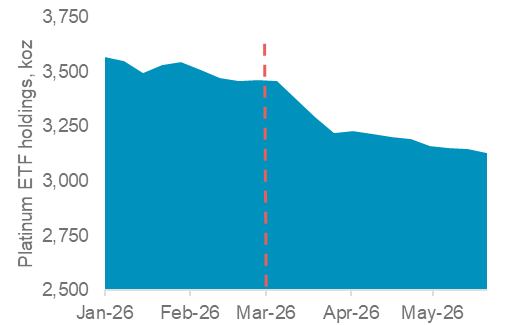
Figure 7: Four years of consecutive platinum market deficits are expected to deplete AGS by 66% from 2022 to 2026f
IMPORTANT NOTICE AND DISCLAIMER: This publication is general and solely for educational purposes. The publisher, The World Platinum Investment Council, has been formed by the world’s leading platinum producers to develop the market for platinum investment demand. Its mission is to stimulate investor demand for physical platinum through both actionable insights and targeted development: providing investors with the information to support informed decisions regarding platinum; working with financial institutions and market participants to develop products and channels that investors need.
This publication is not, and should not be construed to be, an offer to sell or a solicitation of an offer to buy any security. With this publication, the publisher does not intend to transmit any order for, arrange for, advise on, act as agent in relation to, or otherwise facilitate any transaction involving securities or commodities regardless of whether such are otherwise referenced in it. This publication is not intended to provide tax, legal, or investment advice and nothing in it should be construed as a recommendation to buy, sell, or hold any investment or security or to engage in any investment strategy or transaction. The publisher is not, and does not purport to be, a broker-dealer, a registered investment advisor, or otherwise registered under the laws of the United States or the United Kingdom, including under the Financial Services and Markets Act 2000 or Senior Managers and Certifications Regime or by the Financial Conduct Authority.
This publication is not, and should not be construed to be, personalized investment advice directed to or appropriate for any particular investor. Any investment should be made only after consulting a professional investment advisor. You are solely responsible for determining whether any investment, investment strategy, security or related transaction is appropriate for you based on your investment objectives, financial circumstances and risk tolerance. You should consult your business, legal, tax or accounting advisors regarding your specific business, legal or tax situation or circumstances.
The information on which this publication is based is believed to be reliable. Nevertheless, the publisher cannot guarantee the accuracy or completeness of the information. This publication contains forward-looking statements, including statements regarding expected continual growth of the industry. The publisher notes that statements contained in the publication that look forward in time, which include everything other than historical information, involve risks and uncertainties that may affect actual results. The logos, services marks and trademarks of the World Platinum Investment Council are owned exclusively by it. All other trademarks used in this publication are the property of their respective trademark holders. The publisher is not affiliated, connected, or associated with, and is not sponsored, approved, or originated by, the trademark holders unless otherwise stated. No claim is made by the publisher to any rights in any third-party trademarks
WPIC Research MiFID II Status
The World Platinum Investment Council -WPIC- has undertaken an internal and external review of its content and services for MiFID II. As a result, WPIC highlights the following to the recipients of its research services, and their Compliance/Legal departments:
WPIC research content falls clearly within the Minor Non-Monetary Benefit Category and can continue to be consumed by all asset managers free of charge. WPIC research can be freely shared across investment organisations.
- WPIC does not conduct any financial instrument execution business. WPIC does not have any market making, sales trading, trading or share dealing activity. (No possible inducement).
- WPIC content is disseminated widely and made available to all interested parties through a range of different channels, therefore qualifying as a “Minor Non-Monetary Benefit” under MiFID II (ESMA/FCA/AMF). WPIC research is made freely available through the WPIC website. WPIC does not have any permissioning requirements on research aggregation platforms.
- WPIC does not, and will not seek, any payment from consumers of our research services. WPIC makes it clear to institutional investors that it does not seek payment from them for our freely available content.
More detailed information is available on the WPIC website:
https://www.platinuminvestment.com/investment-research/mifid-ii
Contacts:
Edward Sterck, Research, [email protected]
Wade Napier, Research, [email protected]
Brendan Clifford, Head of Institutional Distribution, [email protected]
WPIC does not provide investment advice.
Please see disclaimer for more information.