Industry leaders have recently combined forces to assert their commitment to hydrogen mobility solutions for heavy-duty transport in Europe, united by a shared conviction that hydrogen is an important complement to battery electric vehicles in achieving the European Union’s (EU) decarbonisation targets.
Key among them are automakers and original equipment manufacturers (OEMs) Volvo Group, Daimler Truck, and Toyota Motor Corporation, while the energy and refuelling infrastructure part of the value chain is represented by TotalEnergies, Bosch, Air Liquide, TEAL Mobility, and MB Energy.
These businesses are advocating for a combination of supportive policy frameworks, a strong OEM offering, and an integrated hydrogen supply chain to accelerate the deployment of hydrogen-powered trucks in freight and logistics operations.
Platinum’s superior properties
Platinum is used in the two vehicle powertrains that enable hydrogen mobility – hydrogen fuel cells and hydrogen combustion engines. Fuel cells use proton exchange membrane technology where platinum’s superior catalytic and conductive properties turn hydrogen and oxygen (from air) into electricity, with water and heat as the only by-products. In hydrogen combustion engines, platinum catalysts support the reduction of harmful nitrogen oxide emissions that are produced during the high-temperature combustion process.
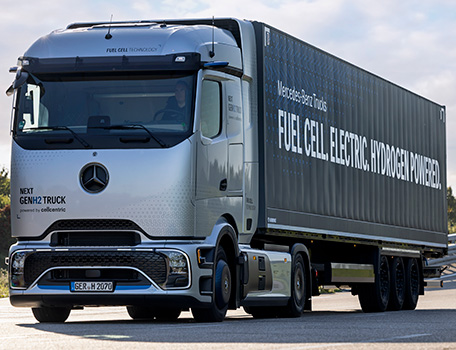
In terms of automaker offering, Volvo and Daimler – whose platforms support both hydrogen fuel cell electric and hydrogen combustion engine trucks – have reaffirmed their commitment to hydrogen powertrains this year. Volvo started on road trials of its hydrogen combustion trucks, while Daimler launched its next generation hydrogen fuel cell electric vehicle (FCEV) truck.
Meanwhile, Toyota has joined Volvo and Daimler in hydrogen fuel cell venture Cellcentric. The collaboration aims to combine Daimler and Volvo's commercial vehicle expertise with Toyota's experience in fuel cells, with a view to developing, producing, and commercialising fuel cell systems for heavy-duty on- and off-road transport. The partners also aim to actively support the development of hydrogen supply and infrastructure.
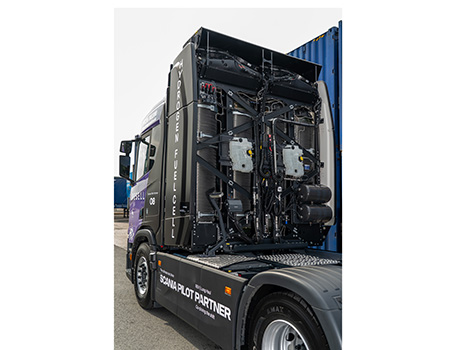
Picture credit: Scania
Toyota’s third-generation fuel cell system, launched last year, has been developed for the specific demands of commercial applications. Compared with the previous generation, it delivers twice the output, twice the durability, 20% better fuel efficiency, and significantly lower cost, bringing fuel cell trucks closer to the performance and operating expectations of diesel fleets while producing zero tailpipe emissions.
Elsewhere, Toyota’s latest fuel cell system is being used for 40 heavy-duty vehicles in Scania’s ‘Pilot Partner’ programme, a collaborative innovation platform where Scania (part of the Volkswagen Group) works with selected logistics and transport customers to test and evaluate new, sustainable transport technologies under real-world operating conditions.
Earlier this month, Scottish transport and logistics company John G Russell (Transport) Ltd became the first operator to put FCEVs into its daily operations on UK roads, deploying three vehicles developed by Scania’s Pilot Partner division. The trial will provide valuable insight into how hydrogen fuel cell technology performs in real-world logistics operations, helping to assess its potential role alongside battery electric vehicles in the transition to net zero freight. The initiative forms part of the ZENFreight project, a UK government-backed programme funded by the Department for Transport and delivered in partnership with Innovate UK.
Toyota has also announced a partnership with IVECO through EMPOWER, the EU-funded project for zero-emission heavy-duty transport. Toyota will provide the fuel cell system for IVECO’s new-generation FCEVs, while IVECO leads vehicle development, integration and validation.